
Insulated Condensing Hive Tops vs Ventilated Hives: Science-Backed Benefits for Cold, Moderate & Warm Climates

An insulated top that creates a condensing hive consistently outperforms a standard, high-airflow hive. Bees evolved in thick-walled tree cavities with high thermal mass, a single small lower entrance, and essentially no top ventilation. Thin wooden Langstroth boxes with upper vents and open airflow reverse that design: they lose heat rapidly, force energy-intensive clustering, and often mismanage moisture. Research across climates shows that heavy top insulation plus controlled lower ventilation (the condensing model) improves survival, reduces food consumption, stabilizes brood temperatures, supports better humidity for honey curing, and can raise productivity.
The Hyve Top design deliberately follows this principle: a heavily insulated lid that converts a standard hive into a condensing configuration with a modest bottom vent, letting bees retain heat and metabolic moisture while directing condensation away from the cluster.
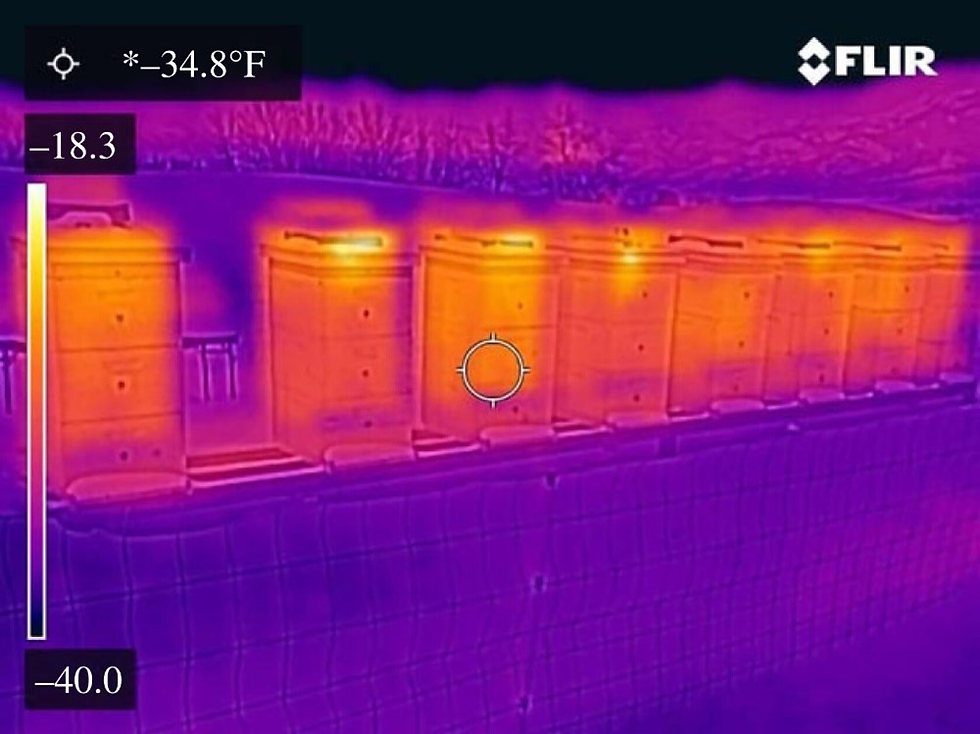
The Core Physics: Heat, Moisture, and the Dew Point
Bees maintain brood near 34–35 °C (≈95 °F). In winter they generate heat metabolically by consuming honey. Warm, moist air rises from the cluster. In a poorly insulated hive with a cold ceiling, that air hits a surface below the dew point and condenses overhead, dripping onto bees. Wet bees chill, the cluster tightens further, and energy demand spikes.
A well-insulated top keeps the ceiling above the dew point. Warm moist air spreads sideways, cools, and condenses on cooler side walls or lower surfaces. Condensation releases latent heat back into the hive, and liquid water can drain or be used by the bees. Upper vents create a “chimney” that continuously dumps both heat and moisture (and CO₂). The condensing approach eliminates that loss while still allowing controlled exchange at the bottom.
Derek Mitchell’s thermal modeling shows that common thin wooden hives lose heat at rates 4–7 times higher than typical tree cavities. Clustering itself is not benign insulation; the dense mantle acts more like a heat sink under severe cold stress. Forcing bees into prolonged tight clusters in leaky boxes is energetically costly and stressful.
Cold Climates: Survival, Stores, and Reduced Stress
In subarctic and cold temperate regions the advantages are clearest.
A controlled trial in the Yukon (subarctic conditions near Whitehorse) compared standard Langstroth hives with heavily insulated versions (thick EPS on walls and especially the top). Insulated colonies showed higher mean internal temperatures, smaller daily temperature ranges, lower and more stable relative humidity, faster early-season comb building, higher early honey-storage rates, and trends toward lower Varroa. They also converted autumn syrup feed more effectively.
In central Illinois (temperate, not extreme cold), a randomized multi-apiary trial found that colonies fitted with corrugated covers plus foam top insulation had 22.5 % higher overwinter survival (4.8 % mortality vs. 27.3 % in uncovered controls) and consumed significantly less of their stores and supplemental sugar. Differences in mass loss became pronounced as brood rearing resumed in late winter.
Beekeepers and researchers working with true condensing setups (heavy top insulation, no upper vents, single lower entrance) routinely report higher survival, lower honey consumption, and earlier spring build-up. The bees remain more dispersed rather than tightly clustered for months, preserving individual longevity and colony strength.
Moderate Climates: Year-Round Stability and Efficiency
In regions with cold winters but milder overall conditions, the same principles reduce energy waste across seasons. Colonies spend less honey maintaining temperature, so more stores remain for spring growth or harvest. Temperature stability supports continuous or earlier brood rearing without the extreme swings of thin-walled boxes.
Insulation also dampens daily and weather-driven fluctuations. Bees do not need to respond as dramatically to every cold front or warm spell. This lower metabolic cost appears as stronger populations, better forage utilization, and often higher net honey yields once the colony is not constantly “paying the heating bill.”
Moisture management remains important. The condensing design keeps relative humidity in ranges favorable for brood and honey curing while preventing free water from raining on the cluster. Traditional high-ventilation approaches can over-dry the hive or create drafts that force compensatory heating.
Warm Climates: Buffering Heat Gain and Supporting Productivity
Insulation is not only a winter tool. In hot climates the roof is the primary solar collector. A thick insulated top reduces radiant heat gain into the hive cavity. Field observations and small trials show that simple Styrofoam or similar top insulation can lower peak internal temperatures by several degrees during heat waves and reduce the amplitude of day–night swings. Bees expend less energy and water on evaporative cooling and fanning.
Studies in warmer and subtropical regions (Turkey, parts of the Middle East, Pakistan, and elsewhere) have recorded higher honey yields, larger populations, and better colony development in insulated or better-buffered hives compared with standard wooden ones. The mechanism is efficiency: colonies start foraging earlier in the day or season, maintain brood more consistently, and waste less energy on thermoregulation. High internal humidity in a well-managed insulated hive can also hinder Varroa reproduction, an additional benefit observed in several contexts.
Even in hot weather the bees still need controlled airflow. A modest bottom vent (or screened bottom board used judiciously) plus the bees’ own fanning provides exchange without the continuous heat loss of large upper openings. The insulated top prevents the roof from becoming a heat source while the colony manages internal climate.
Additional Benefits Supported by Research
Lower forced clustering and better welfare — Mitchell’s work reframes prolonged tight clustering as a stress response rather than the ideal state. Better-insulated cavities allow more dispersed, lower-metabolism overwintering closer to natural tree-nest behavior.
Varroa and disease dynamics — Higher, more stable humidity and reduced stress can limit mite reproductive success in some studies; stronger colonies also tolerate pests better.
Honey curing and stores — Controlled moisture removal via condensation rather than wholesale ventilation helps bees dry nectar efficiently while retaining latent heat.
Productivity — Multiple trials report earlier spring build-up, higher early honey storage rates, and net yield advantages once energy savings compound.
Practical Design Implications
The highest-leverage single change is often the top. Heavy insulation (R-10 or greater equivalent on the roof) keeps the ceiling warm. Pair it with a single lower entrance or modest bottom vent so excess moisture can leave or condense safely low in the hive. Avoid large upper vents that recreate the chimney effect. The result is a condensing hive that works with convection rather than fighting it.
This is exactly the configuration an insulated smart hive top delivers: rigid foam insulation converting a standard Langstroth into a condensing system, a controlled bottom vent, and the ability to monitor the resulting stable temperature and humidity environment. In cold climates the priority is survival and store conservation; in moderate climates it is efficiency and stronger spring colonies; in warm climates it is reduced heat stress and sustained productivity. Across all three, the physics and the field data align: an insulated, condensing top is superior to a standard high-airflow design.
The evidence continues to grow as more beekeepers and researchers instrument real hives. The consistent pattern is that mimicking the thermal properties of a natural tree cavity—especially at the top—pays measurable dividends in colony health and performance.
Key sources and URLs used for the blog post data:
Peer-Reviewed / Primary Research
Honey bee hive covers reduce food consumption and colony mortality during overwintering (PLOS One, 2022 – Illinois temperate climate study) https://journals.plos.org/plosone/article?id=10.1371/journal.pone.0266219
Honeybee cluster—not insulation but stressful heat sink (Journal of The Royal Society Interface, 2023 – Derek Mitchell) https://royalsocietypublishing.org/doi/10.1098/rsif.2023.0488 (Alternate view: https://royalsocietypublishing.org/rsif/article/20/208/20230488/90609/Honeybee-cluster-not-insulation-but-stressful-heat)
Ratios of colony mass to thermal conductance of tree and man-made nest enclosures of Apis mellifera (Derek Mitchell, 2016) https://pubmed.ncbi.nlm.nih.gov/26335295/
Yukon insulated vs. standard hive study (Eoin Sheridan / Yukon University – subarctic conditions) https://www.yukonu.ca/sites/default/files/inline-files/Eoin%20Sheridan%20-%20HIVE%20V3.pdf
Polyurethane honey bee hives provide better winter insulation than wooden hives (Journal of Apicultural Research) https://www.tandfonline.com/doi/full/10.1080/00218839.2021.1999578
Condensing Hive Concept & Supporting Analysis
Understanding the Condensing Hive Concept (Betterbee – Bill Hesbach) https://www.betterbee.com/instructions-and-resources/condensing-hive-concept.asp
The Hidden Thermodynamics Inside Your Beehive (Texas Bee Haus) https://www.texasbeehaus.com/beehive-thermal-dynamics-insulated-vs-non-insulated/
Additional Supporting Sources
Phys.org summary of Mitchell’s clustering research: https://phys.org/news/2023-11-honeybees-cluster-cold-weve-wrong.html
Bee Culture – “Winter is Coming” (tree cavity vs. managed hive discussion): https://beeculture.com/winter-is-coming-2/
These are the main sources that supplied the quantitative findings (survival rates, temperature/humidity differences, food consumption, thermal modeling, and condensing-hive principles) referenced in the post.

Comments